
Bounds
Bounds boundary class
Key Properties
x: number
x-axis coordinate.
y: number
y-axis coordinate.
width: number
Width, may be negative.
height: number
Height, may be negative.
Readonly Properties
minX: number
Minimum x-axis coordinate.
minY: number
Minimum y-axis coordinate.
maxX: number
Maximum x-axis coordinate.
maxY: number
Maximum y-axis coordinate.
Key Methods
When returning Bounds, chained operations are supported.
set ( x: number | IBoundsData = 0, y = 0, width = 0, height = 0 ): Bounds
Set boundary data, same parameters as new Bounds(), default is 0,0,0,0.
get ( ): IBoundsData
Get boundary data object {x,y,width,height}.
clone ( ): Bounds
Clone a Bounds object.
put ( put: IBoundsData, align: IAlign = 'center', putScale?: IPutScale )
Place a bounding box into a specified position, and automatically adjust the position and size of put after alignment and scaling.
align represents the alignment position, default is centered placement, putScale represents scaling size, default is 1.
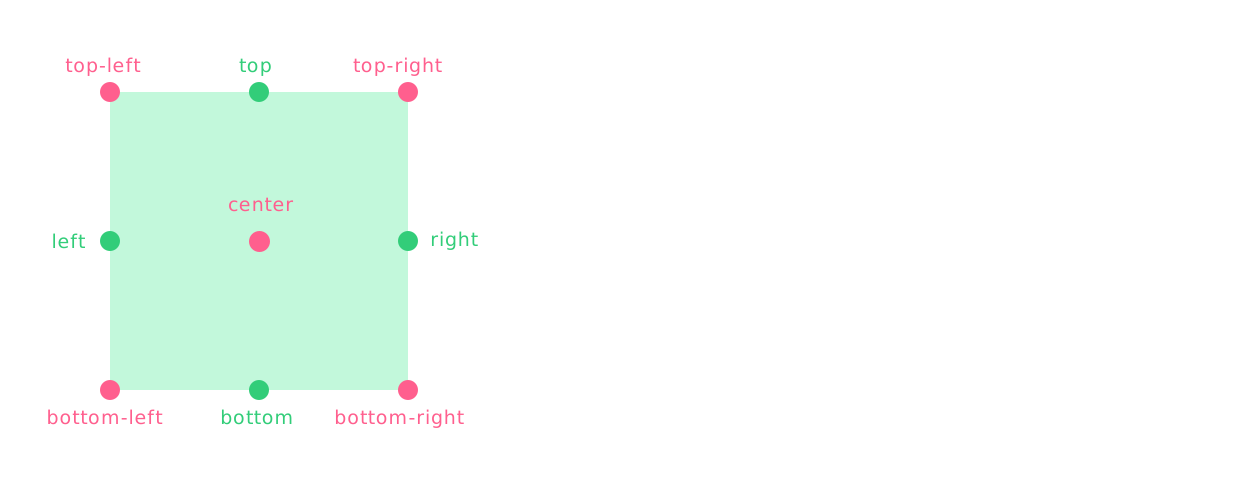
// Direction
type IAlign =
  | 'top-left'
  | 'top'
  | 'top-right'
  | 'right'
  | 'bottom-right'
  | 'bottom'
  | 'bottom-left'
  | 'left'
| 'center'type IPutScale =
| number // specify scale ratio
| 'cover' // cover (similar to background-size: cover)
| 'fit' // fit (similar to background-size: contain)Scaling
scale ( scaleX: number, scaleY = scaleX, onlySize?: boolean ): Bounds
Scale the current Bounds around the origin (0, 0).
When onlySize is true, only width and height are scaled.
scaleOf ( origin: IPointData, scaleX: number, scaleY = scaleX ): Bounds
Scale the current Bounds around the origin point.
Adjustment
spread ( fourNumber: IFourNumber ): Bounds
Expand the boundary outward.
shrink ( fourNumber: IFourNumber ): Bounds
Shrink the boundary inward.
ceil ( ): Bounds
Round up the boundary so that x, y, width, height all become integers, ensuring it still contains the previous Bounds.
unsign ( ): Bounds
Convert width and height that may be negative into positive values, affecting x and y.
Add
add ( bounds:IBoundsData ): Bounds
Add a bounds.
addList ( boundsList: IBoundsData[] ): Bounds
Add a list of bounds.
setList ( boundsList: IBoundsData[] ): Bounds
Set boundary data from a bounds list.
addListWithFn ( list: IObject[], boundsDataFn: IBoundsDataFn ): Bounds
Add a bounds list via traversal function. When iterating list, the actual BoundsData is returned by calling boundsDataFn.
Usage scenario
The list item itself is not Bounds, but one of its properties is Bounds.
setListWithFn ( list: IObject[], boundsDataFn: IBoundsDataFn ): Bounds
Set boundary data from a bounds list generated by a traversal function.
Coordinates
setPoint ( point: IPointData): Bounds
Set boundary data from a coordinate point, width and height will be 0.
addPoint ( point: IPointData): Bounds
Add a coordinate point.
setPoints ( points: IPointData[] ): Bounds
Set boundary data from a set of coordinate points.
getPoints ( ): IPointData[]
Get the 4 coordinate points [topLeft, topRight, bottomRight, bottomLeft].
getPoint ( around: IAround, onlyBoxSize?: boolean, to?: IPointData ): IPointData
Get the coordinate of the around point in the bounding box.
onlyBoxSize means excluding the starting coordinate of Bounds, default is false.
If to exists, the result will be assigned to to.
Collision Detection
hitPoint ( point: IPointData, pointMatrix?: IMatrixData ): boolean
Check whether it collides with a coordinate point. The passed point supports temporarily applying a matrix pointMatrix.
hitRadiusPoint ( point: IRadiusPointData, pointMatrix?: IMatrixWithScaleData ):boolean
Check whether it collides with a coordinate point with radius. The passed point supports temporarily applying a matrix pointMatrix (requires scaleX and scaleY), commonly used for cursor picking.
hit ( bounds: IBoundsData, boundsMatrix?: IMatrixData ): boolean
Check whether it collides with another bounds. The passed bounds supports temporarily applying a matrix boundsMatrix.
includes ( bounds: IBoundsData, boundsMatrix?: IMatrixData ): boolean
Check whether it contains another bounds. The passed bounds supports temporarily applying a matrix boundsMatrix.
Intersection
intersect ( bounds: IBoundsData, boundsMatrix?: IMatrixData ): Bounds
Perform intersection with another bounds, only keeping the overlapping part. The passed bounds supports temporarily applying a matrix boundsMatrix.
getIntersect ( bounds: IBoundsData, boundsMatrix?: IMatrixData ): Bounds
Get the intersection with another bounds. The passed bounds supports temporarily applying a matrix boundsMatrix.
Check
isSame ( bounds: IBoundsData ): boolean
Check whether it is equal to another bounds.
isEmpty ( ): boolean
Check whether it is an empty bounds, all properties are 0.
reset ( ): void
Reset the boundary.
Matrix Methods
toOuterOf ( matrix: IMatrixData , to?: IBoundsData ): Bounds
Convert to the external AABB bounding box of the matrix (assuming current is internal bounds). If to exists, the result will be assigned to to.
getFitMatrix ( put: IBoundsData ): IMatrix
Place another bounds into the current bounds and return an optimal fit matrix.
Examples
Create via property values
import { Bounds } from 'leafer-ui'

const bounds = new Bounds(0, 0, 100, 100)
Create via data object
const boundsData = { x: 0, y: 0, width: 100, height: 100 }

const bounds = new Bounds(boundsData)
Chained operations
const bounds = new Bounds()

bounds.set(0, 0, 100, 100).hitPoint({ x: 50, y: 50 }) // true